
Other Insights


Dec 4 2025
AI at Work: How Microsoft 365 Copilot Is Moving Sales, Service, and Finance Teams to the Frontier


















Sep 25 2022
What does Packaged foods, Medical/Pharma, Health Providers, Real Estate and Beverages have in common?


Need help or want to know more?
Find our contact info here
“DynamicsPrint® with IMP is the heart of our planning estimations and imposition systems.
Estimating has become an important science. Our young estimators can deliver accurate plans just as an experienced estimator, with loads of experience, would.”
Angel Viveros, Estimation Manager
Foli De Mexico, Mexico
“The reason we chose DP was because it’s an industry solution which solves many of the problems we had in the standard Microsoft Dynamics setup. Also, there was demand from the management to have final costing, which was also a major challenge in the standard Dynamics solution.
DynamicsPrint® also helps us greatly with scheduling and shop floor management. The data gathered gives us great insights, and results in a much more cost-efficient production.”
Jochem Sants, Project Manager
Van der Most, Heerde, Netherlands
“The professional and highly skilled DynamicsPrint® team led the implementation to develop the expertise internally at DCM with a team of Subject Matter Experts from each of the specialized print production areas. DynamicsPrint’s expertise regarding the system and the industry was instrumental to ensuring the configurations were done properly. As this is a highly configurable solution, the approach and implementation was very well structured and ensured that the team worked from the basic setups to the more complex setups with a pace that was manageable and retainable.
DynamicsPrint® adjusted the resource requirements to accommodate both technical and functional areas of expertise as needed throughout the project, providing best practice directives to ensure that the proper approach was being followed.”
Karen Redfern, VP Operations Technology
DCM, Canada
“I just wanted to let you know how happy I am with DynamicsPrint® and the support you have given KP San Leandro since our launch. The seemingly endless set of tools available really help us run and improve our business.
The visibility into job statuses, P&L, and the ability to create and manage cues that give our team a personalized look into their own area of responsibility have become essential to our business model. I can’t even imagine going back to our old system. Thanks to the DynamicsPrint® team for all your help and support.”
Mark Floyd, Division Director
KP Corp. San Leandro, USA
Commercial printing is navigating one of the most uncertain periods in recent history. Tariff volatility, cost inflation, and shifting client behavior have combined to create a challenging operating environment. Yet beneath the economic turbulence lies something more significant than a typical business cycle.
The industry is experiencing structural change.
A Difficult 2025 Sets the Stage
Results from the PRINTING United Alliance State of the Industry Survey illustrate how challenging conditions have been:
Sales growth averaged just 0.3% through the first three quarters of 2025
Operating cost inflation (3.9%) exceeded price increases (2.1%)
Real production declined 1.8%
72.3% of printers reported flat or declining pre-tax profitability
Respondents cited economic uncertainty, tariff policy volatility, rising labor and substrate costs, and clients delaying or reducing run sizes.
Looking ahead, 61% of commercial printers are most concerned about increasing sales, 52.4% about maintaining profitability, and 51.2% about broader economic conditions.
Four Strategic Priorities for 2026
Despite economic pressure, the industry is not standing still. Research respondents identified more than 30 priorities for the coming year, clustered into four dominant themes.
1. World-Class Efficiency
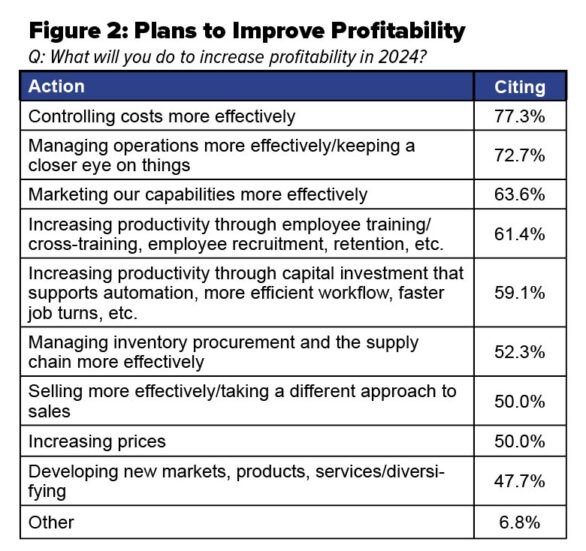
Productivity, cost control, and automation rank at the top of strategic agendas. With markets too competitive to absorb inefficiencies, printers are focusing on:
Companywide productivity gains
Plugging cost “leaks”
Automation in production and workflow
Quality control improvements
Faster turnaround times
Efficiency is no longer incremental improvement, it is survival strategy.
2. Profitable Revenue Growth
Commercial printers are diversifying beyond traditional work. Many have expanded into:
Graphic and sign printing
Package and label production
Mailing and fulfillment services
The emphasis is shifting toward value-added services, improved customer experience, expanded e-commerce capabilities, and capturing higher-margin opportunities.
3. Artificial Intelligence
AI is no longer theoretical. Companies are actively evaluating how it can support:
Sales prospecting
Forecasting and market analysis
Preventive maintenance
Cash management
AI’s ability to improve speed, precision, and predictive insight makes it central to structural transformation.
4. Business Intelligence
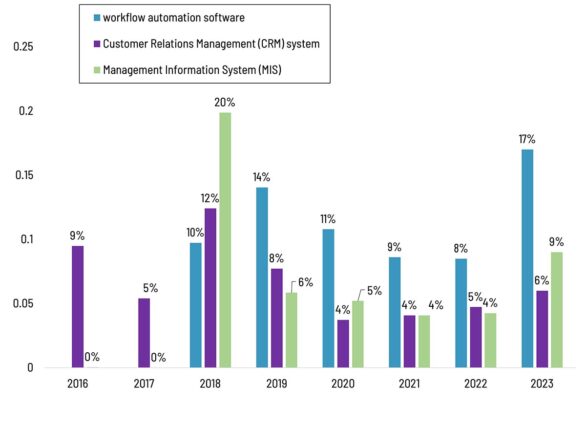
Stronger ERP, MIS, CRM, and data systems are increasingly viewed as essential infrastructure. Timely, integrated data enables better internal visibility and more informed strategic decisions.
In a volatile market, clarity becomes a competitive advantage.
Capital Investment: Hesitation and Focus
Capital investment intentions have softened amid uncertainty. The share of companies planning investments declined compared to earlier in the year, while more printers report delaying or reconsidering spending.
Yet the nature of desired investments is revealing. Leading priorities include:
Bindery and finishing systems to remove bottlenecks
Production inkjet technology for short- and mid-run efficiency
AI integration across business functions
Mailing and fulfillment capabilities
E-commerce platforms
Even amid caution, modernization remains the underlying direction.
Cyclical vs. Structural Change
Economic cycles are familiar. Interest rates rise and fall. Inflation moderates. Policy shifts. Businesses adapt.
Structural change is different.
Driven by AI, IoT, robotics, and cloud infrastructure, structural change alters how value is created. It widens the gap between those who adapt and those who rely on legacy models.
Unlike cyclical shifts, structural change does not allow a passive strategy. There is no “wait it out” option.
The widening divide between industry leaders and others reflects differences in automation adoption, data utilization, workforce development, and technology integration.
The 2026 Outlook
Macroeconomic conditions may improve in 2026, supported by productivity gains and potential capital investment incentives. However, improved economic conditions alone will not guarantee improved results for every commercial printer.
Success increasingly belongs to organizations that:
Embrace automation and robotics
Invest in cloud-based infrastructure
Develop pragmatic AI strategies
Strengthen risk management and scenario planning
Continue investing during uncertainty rather than waiting for clarity
In periods of extreme uncertainty, moving forward carries risk. But standing still may carry greater risk.
For commercial printers prepared to treat structural change as opportunity rather than threat, the outlook for 2026 is bright.
Book Demo