Connected Production Is Becoming the Competitive Advantage in Corrugated Manufacturing
Aug 25 2026

Other Insights


Dec 4 2025
AI at Work: How Microsoft 365 Copilot Is Moving Sales, Service, and Finance Teams to the Frontier

















Sep 25 2022
What does Packaged foods, Medical/Pharma, Health Providers, Real Estate and Beverages have in common?


Need help or want to know more?
Find our contact info here
“DynamicsPrint® with IMP is the heart of our planning estimations and imposition systems.
Estimating has become an important science. Our young estimators can deliver accurate plans just as an experienced estimator, with loads of experience, would.”
Angel Viveros, Estimation Manager
Foli De Mexico, Mexico
“The reason we chose DP was because it’s an industry solution which solves many of the problems we had in the standard Microsoft Dynamics setup. Also, there was demand from the management to have final costing, which was also a major challenge in the standard Dynamics solution.
DynamicsPrint® also helps us greatly with scheduling and shop floor management. The data gathered gives us great insights, and results in a much more cost-efficient production.”
Jochem Sants, Project Manager
Van der Most, Heerde, Netherlands
“The professional and highly skilled DynamicsPrint® team led the implementation to develop the expertise internally at DCM with a team of Subject Matter Experts from each of the specialized print production areas. DynamicsPrint’s expertise regarding the system and the industry was instrumental to ensuring the configurations were done properly. As this is a highly configurable solution, the approach and implementation was very well structured and ensured that the team worked from the basic setups to the more complex setups with a pace that was manageable and retainable.
DynamicsPrint® adjusted the resource requirements to accommodate both technical and functional areas of expertise as needed throughout the project, providing best practice directives to ensure that the proper approach was being followed.”
Karen Redfern, VP Operations Technology
DCM, Canada
“I just wanted to let you know how happy I am with DynamicsPrint® and the support you have given KP San Leandro since our launch. The seemingly endless set of tools available really help us run and improve our business.
The visibility into job statuses, P&L, and the ability to create and manage cues that give our team a personalized look into their own area of responsibility have become essential to our business model. I can’t even imagine going back to our old system. Thanks to the DynamicsPrint® team for all your help and support.”
Mark Floyd, Division Director
KP Corp. San Leandro, USA
A recent article from Keypoint Intelligence explores one of the biggest shifts currently taking place in the corrugated industry. The move away from evaluating individual production technologies and toward building fully connected manufacturing environments.
While digital printing continues to evolve, the conversation is increasingly focused on something much broader. How information moves across the entire production process.
Looking Beyond Individual Machines
For many years, discussions around production investments centered on machine performance.
Today, those conversations are changing.
According to the article, corrugated converters are facing increasing pressure from:
These challenges cannot be solved by installing faster equipment alone.
Instead, organizations are asking how every investment contributes to improving the performance of the entire operation.
The Value of Connected Workflows
One of the article’s central themes is that operational performance depends on how well each stage of production connects with the next.
Scheduling, material movement, production, converting, finishing, quality control, and reporting all generate valuable operational data. When these processes operate independently, visibility becomes limited and decision-making slows.
Connected workflows provide organizations with a clearer understanding of:
Rather than simply collecting more data, connected manufacturing helps organizations use that information to improve day-to-day decision-making.
Real-Time Visibility Drives Better Decisions
The article also highlights the growing importance of reliable production data.
As manufacturing environments become more automated, real-time operational information becomes increasingly valuable for production planning, scheduling, predictive maintenance, quality management, and continuous improvement.
This is particularly true on the shop floor.
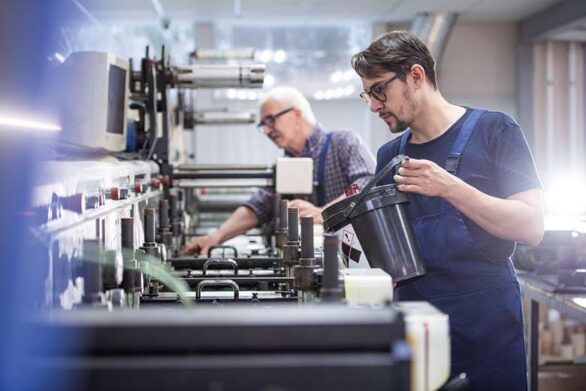
When production teams have immediate access to live job information, work status, material consumption, and production progress, they can respond more quickly to changing priorities while maintaining greater control over operations.
Likewise, planners and customer service teams benefit from having accurate production visibility, allowing them to make better scheduling decisions and provide more reliable customer updates.
Connectivity Is the Foundation
At FESPA 2026, one message stood out consistently throughout the corrugated exhibits. Connectivity itself is not the end goal.
Instead, connected systems provide the foundation for broader operational improvements, including automation, analytics, artificial intelligence, sustainability initiatives, and continuous optimization.
As the article explains, technologies such as predictive maintenance, intelligent scheduling, robotics, and advanced analytics all depend on consistent, reliable operational data flowing throughout the organization.
A Broader Industry Shift
Although the article focuses on corrugated production, the underlying message applies across much of the printing and packaging industry.
Organizations are increasingly investing in solutions that improve visibility across the entire production workflow rather than optimizing individual departments in isolation.
For many businesses, this means creating stronger connections between planning, scheduling, production, quality management, reporting, and the shop floor.
Solutions such as integrated Shop Floor Control illustrate this broader industry direction by enabling operators, planners, production managers, and customer service teams to work from the same real-time production information. This kind of visibility helps reduce manual communication, improve scheduling accuracy, and support faster operational decisions without disrupting existing workflows.
Looking Ahead
The article concludes that connected manufacturing will not arrive through one transformational investment.
Instead, progress will come through a series of incremental improvements that connect systems, improve data flow, automate manual processes, and provide better operational visibility.
As customer expectations continue to rise and production environments become increasingly complex, organizations that prioritize connected workflows and real-time operational insight will be better positioned to improve efficiency, reduce waste, and make faster, more confident business decisions.
Ultimately, the future of manufacturing will be defined not simply by faster machines, but by how effectively every part of the operation works together.
Book Demo